Retrieval-Augmented Generation (RAG) is not one architecture. It is a family of patterns for grounding model answers in your data.
This guide walks through the five patterns you will actually meet in enterprise designs — Naive, Advanced, Modular, Agentic, and GraphRAG — using one shared business scenario, a solution architecture, and a sample implementation sketch for each.
If you only remember one rule: complexity should follow failure modes, not LinkedIn trends.
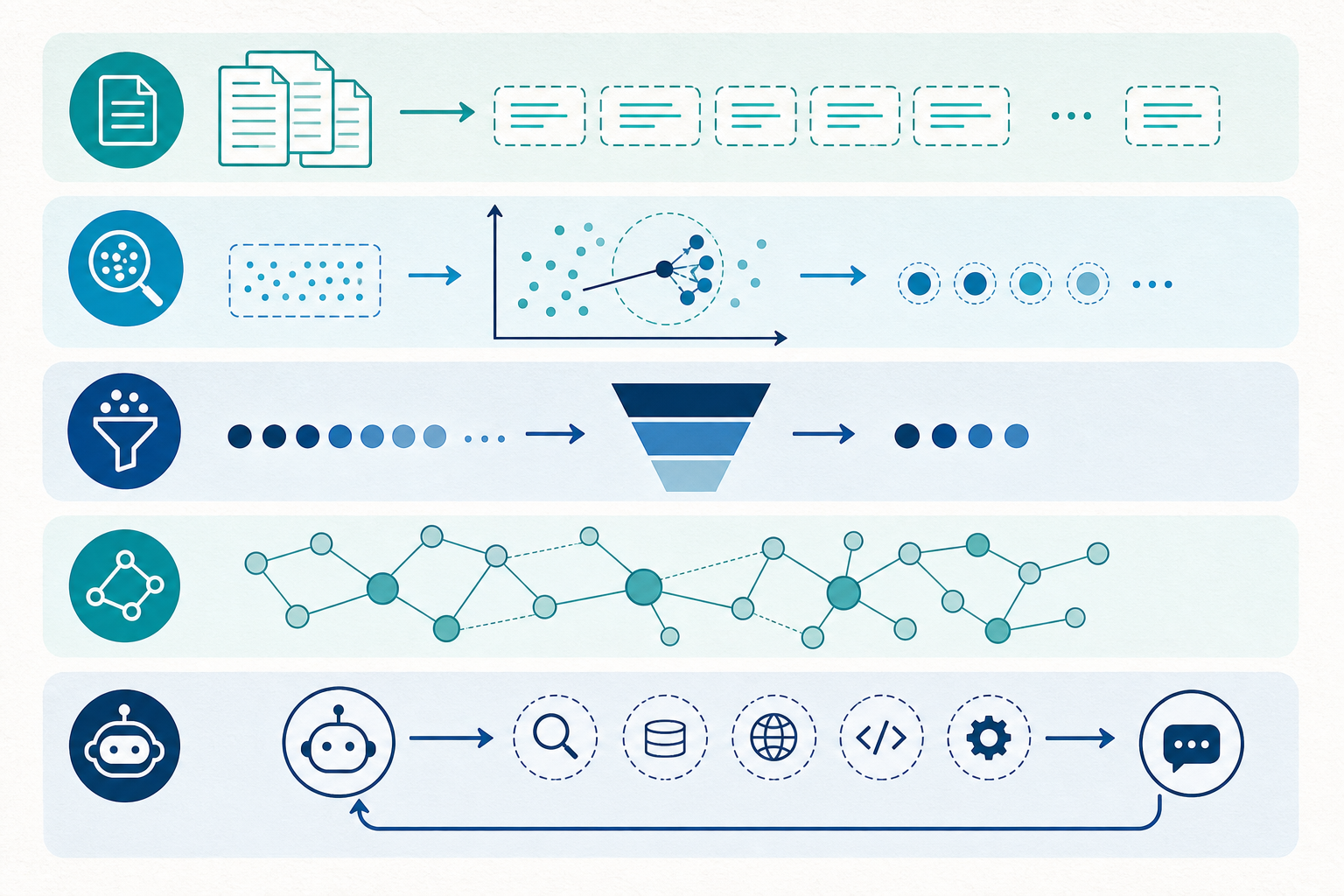
Shared scenario (used for every pattern)
Company: Northwind Mobility, a global automotive OEM.
Use case: an internal assistant for dealer support and warranty analysts.
Questions look like:
- “What is the warranty policy for battery degradation in Germany for MY2024?”
- “Which systems own VIN → vehicle config → claim status?”
- “Summarise open severity-1 issues for model Apex in the EU region.”
Knowledge sources:
- Policy PDFs & SharePoint (warranty, regional exceptions)
- Service bulletins (unstructured)
- CRM / case history (Salesforce)
- Claim status API (MuleSoft / Anypoint)
- Org & product hierarchy (who owns which region/model)
We will solve the same question across patterns:
Q: “Can we approve a goodwill battery replacement for VIN WNW123 in Bavaria, and who must sign off?”
1. Naive RAG
Linear pipeline: chunk → embed → top‑k similarity → stuff into prompt → generate.
When it fits
POC on a clean corpus (e.g. one warranty PDF library). Breaks on multi-hop questions, ACL, and “similar but wrong” chunks.
Solution architecture
┌──────────────┐    ┌─────────────┐    ┌──────────────┐
│ Ingestion    │───▶│ Vector DB   │◀───│ Query Embed  │
│ (chunk+embed)│    │ (policies)  │    │              │
└──────────────┘    └──────┬──────┘    └──────┬───────┘
                           │ top-k            │
                           ▼                  │
                    ┌─────────────┐           │
                    │ Prompt+LLM  │◀──────────┘
                    └──────┬──────┘
                           ▼
                      Answer text
Components: object storage → chunker → embedding model → vector index (e.g. pgvector / OpenSearch kNN) → chat LLM. No rerank, no hybrid search, no tools.
Example behaviour on our question
Retrieves chunks about “battery goodwill” and “Germany warranty,” but may miss Bavaria sign-off matrix and live claim status. Risk: confident wrong answer.
Sample implementation
def naive_rag(question: str, k: int = 5) -> str:
    q_vec = embed(question)
    chunks = vector_db.similarity_search(q_vec, k=k)
    context = "\n\n".join(c.text for c in chunks)
    prompt = f"""Answer using ONLY the context. If missing, say you don't know.
Context:
{context}

Question: {question}
Answer:"""
    return llm.generate(prompt)
Ingest sketch:
for doc in load_pdfs("s3://nw-warranty/"):
    for chunk in split(doc, size=800, overlap=120):
        vector_db.upsert(id=chunk.id, vector=embed(chunk.text),
                         metadata={"source": doc.path, "region": doc.region})
2. Advanced RAG
Same backbone, but quality controls at every stage: better chunking, query rewrite, hybrid retrieval (BM25 + vectors), reranking, compression, citations.
When it fits
Default production pattern for knowledge Q&A. This is where most enterprise assistants should live before agents or graphs.
Solution architecture
User Q
  │
  ▼
┌─────────────────┐
│ Query transform │  (rewrite / expand / HyDE optional)
└────────┬────────┘
         ▼
┌─────────────────┐     ┌──────────────┐
│ Hybrid retrieve │────▶│ Reranker     │
│ BM25 + vectors  │     │ (cross-enc.) │
└─────────────────┘     └──────┬───────┘
                               ▼
                        ┌──────────────┐
                        │ Compress +   │
                        │ cite chunks  │
                        └──────┬───────┘
                               ▼
                        ┌──────────────┐
                        │ LLM answer   │
                        │ + citations  │
                        └──────────────┘
Enterprise add-ons: metadata filters (region=DE), document ACL from IdP, evaluation set (groundedness / citation precision).
Example behaviour
Query rewritten to “Germany MY2024 battery goodwill approval authority Bavaria.” Hybrid search finds the regional exception table; reranker promotes the sign-off matrix chunk; answer cites policy §4.2.
Sample implementation
def advanced_rag(question: str, user_region: str) -> dict:
    rewritten = llm.generate(
        f"Rewrite for retrieval. Keep entities. Question: {question}"
    )
    dense = vector_db.similarity_search(embed(rewritten), k=20,
                                        filter={"region": ["DE", "GLOBAL"]})
    sparse = bm25_index.search(rewritten, k=20)
    candidates = rrf_fuse(dense, sparse)  # reciprocal rank fusion
    ranked = reranker.rank(question, candidates)[:6]
    context = format_with_citations(ranked)
    answer = llm.generate(f"""Use context. Cite sources like [1],[2].
If policy conflicts, state the conflict.
Context:
{context}

Question: {question}""")
    return {"answer": answer, "sources": ranked}
3. Modular RAG
Composable pipelines with a router. Different question types hit different indexes/tools. Feels like an integration flow — because it is.
When it fits
Multiple domains (policy vs CRM vs product), strict permissions, or different SLAs per corpus.
Solution architecture
                    ┌──────────────────┐
                    │ Intent router    │
                    │ (LLM or rules)   │
                    └────────┬─────────┘
           ┌─────────────────┼─────────────────┐
           ▼                 ▼                 ▼
    ┌────────────┐   ┌────────────┐    ┌────────────┐
    │ Policy RAG │   │ CRM RAG    │    │ Live API   │
    │ (Advanced) │   │ + ACL      │    │ (claims)   │
    └─────┬──────┘   └─────┬──────┘    └─────┬──────┘
          └────────────────┼─────────────────┘
                           ▼
                    ┌────────────┐
                    │ Synthesizer│──▶ Answer
                    └────────────┘
Platform view: API gateway / MuleSoft exposes GET /claims/{vin}; RAG orchestrator is just another consumer with scoped credentials. Identity (OIDC) propagates into metadata filters.
Example behaviour
Router emits: policy + claims_api + org_matrix. Policy module returns goodwill rules; claims API returns open claim state for VIN WNW123; synthesizer merges “eligible / not eligible + approver role.”
Sample implementation
def modular_rag(question: str, user: User) -> str:
    plan = router.classify(question)
    # plan.routes eg: ["policy", "claims", "org"]
    bundles = []
    if "policy" in plan.routes:
        bundles.append(advanced_rag(question, user.region))
    if "claims" in plan.routes:
        vin = extract_vin(question)
        bundles.append({"claims": claims_api.get_status(vin, token=user.token)})
    if "org" in plan.routes:
        bundles.append(org_index.search("battery goodwill approver Bavaria"))
    return synthesizer.merge(question, bundles, cite=True)
# Router can be rules-first for production predictability:
RULES = [
  (r"VIN|claim|status", ["claims", "policy"]),
  (r"who (approves|signs)|sign-off", ["org", "policy"]),
  (r".*", ["policy"]),
]
4. Agentic RAG
An agent decides when and how to retrieve, can loop, call tools, and stop when evidence is enough. Retrieve is a tool — not a single forced step.
When it fits
Multi-step investigate → gather → decide workflows. Higher cost/latency; needs guardrails.
Solution architecture
┌─────────────────────────────────────────┐
│ Agent orchestrator (ReAct / plan-exec)  │
│  memory · policy guardrails · budget    │
└───────────────┬─────────────────────────┘
                │ tool calls
     ┌──────────┼──────────┬────────────┐
     ▼          ▼          ▼            ▼
 search_policy claims_api org_lookup  ticket_search
     │          │          │            │
     └──────────┴─────┬────┴────────────┘
                      ▼
               final answer + audit trail
Controls: max steps, allow-listed tools, human escalate if confidence low, full tool-call audit log.
Example behaviour
- Agent extracts VIN + region
- Calls
claims_api - Searches policy with rewritten query
- Looks up approver role for Bavaria
- Stops with a structured recommendation + citations + next human action
Sample implementation
TOOLS = {
  "search_policy": lambda q: advanced_rag(q, "DE")["sources"],
  "get_claim": lambda vin: claims_api.get_status(vin),
  "get_approver": lambda region, topic: org_api.approver(region, topic),
}

def agentic_rag(question: str, user: User) -> str:
    state = {"question": question, "notes": [], "steps": 0}
    while state["steps"] < 6:
        decision = llm.plan_next_action(state, tools=TOOLS.keys())
        if decision.action == "answer":
            return llm.final_answer(state, decision.draft)
        result = TOOLS[decision.action](**decision.args)
        state["notes"].append({"tool": decision.action, "result": result})
        state["steps"] += 1
    return escalate_to_human(state)
# Tool contract example (OpenAPI-ish)
# POST /tools/get_claim
# body: { "vin": "WNW123" }
# auth: user-delegated OAuth (no god-mode service account)
5. GraphRAG
Build a knowledge graph (entities + relationships + communities). Retrieve by neighbourhood / community summaries — not only vector similarity. Strong when the answer is in the links.
When it fits
“Who owns what,” dependency chains, org/product hierarchies, multi-document relationship questions. Costly to build/maintain — use when Advanced RAG keeps missing relationships.
Solution architecture
Documents ──▶ Entity/Rel extract ──▶ Graph DB (Neo4j etc.)
                      │                      │
                      │                      ├─ local search (entity neighbourhood)
                      │                      └─ global search (community summaries)
                      ▼
              Vector index (optional hybrid)
                      │
                      ▼
                 Graph+text context ──▶ LLM answer
Inspired by community-summary approaches (e.g. Microsoft GraphRAG style pipelines): extract → graph → Leiden/community summaries → local/global retrieval modes.
Example behaviour
Graph paths:
(VIN WNW123)-[:IN_REGION]->(Bavaria)-[:IN_COUNTRY]->(Germany)
(BatteryGoodwill)-[:REQUIRES_APPROVAL]->(Role: Regional Warranty Lead)
(Regional Warranty Lead)-[:FILLED_BY]->(Persona / queue)
Answer names the role and why — even if those facts never co-occur in one PDF chunk.
Sample implementation
def build_graph(docs):
    for doc in docs:
        ents, rels = llm.extract_entities_relations(doc.text)
        graph.upsert_entities(ents)
        graph.upsert_relations(rels)
    graph.run_community_detection()
    graph.materialize_community_summaries()

def graph_rag(question: str) -> str:
    mode = "local" if looks_entity_specific(question) else "global"
    if mode == "local":
        seeds = entity_linker.link(question)
        subgraph = graph.expand(seeds, hops=2)
        context = render_subgraph(subgraph)
    else:
        communities = graph.top_communities_for(question, k=5)
        context = "\n".join(c.summary for c in communities)
    return llm.generate(f"Answer from graph context:\n{context}\n\nQ:{question}")
// Cypher-ish local retrieval
MATCH (v:VIN {id:$vin})-[:IN_REGION]->(r:Region)-[:IN_COUNTRY]->(c:Country)
MATCH (p:PolicyTopic {name:'BatteryGoodwill'})-[:REQUIRES_APPROVAL]->(role:Role)
WHERE c.code = 'DE'
RETURN r.name, role.name, p.clauseRef
Side-by-side: same question, different patterns
| Pattern | What you get for the VIN goodwill question | Main risk |
|---|---|---|
| Naive | Generic warranty blurb | Misses sign-off + live claim state |
| Advanced | Cited policy answer for DE/MY2024 | Still no live claim / org path unless in docs |
| Modular | Policy + claims API + org matrix merged | Router mistakes / integration auth |
| Agentic | Multi-step investigation with audit trail | Latency, cost, runaway loops |
| GraphRAG | Relationship-native “who approves” | Graph build & drift over time |
Reference enterprise architecture (production)
┌──────────── users / IdP (SSO) ────────────┐
│  Assistant UI  →  Orchestration API       │
└─────────────┬─────────────────────────────┘
              │
     ┌────────┴────────┐
     │ Policy engine   │  (PII redaction, tool allow-list)
     └────────┬────────┘
              │
 ┌────────────┼────────────┬──────────────┐
 ▼            ▼            ▼              ▼
Vector/BM25  Graph DB   Systems APIs   Eval/Obs
indexes      (optional) (CRM/Claims)   (traces,
                                        groundedness)
Non-negotiables in enterprise RAG:
- User-delegated auth to tools (no shared god account)
- Document ACLs enforced at retrieval time
- Citations + refusal when evidence is weak
- Evaluation set before you celebrate a demo
- Ownership for ingestion freshness (stale index = silent failure)
This is why RAG is an API and integration problem as much as an LLM problem.
Adoption path that works
- Naive — prove value on one trusted corpus (1–2 weeks)
- Advanced — hybrid + rerank + citations + eval harness
- Modular — split domains / add live APIs behind the router
- Agentic — only when multi-step tool use is the real job
- GraphRAG — when relationship questions keep beating vector search
Final take
Don’t ask “Which RAG is best?” Ask “Which failure is killing trust today?”
- Wrong chunk? → Advanced (hybrid + rerank)
- Wrong system? → Modular (+ APIs)
- Wrong sequence of steps? → Agentic
- Wrong relationships? → GraphRAG
Start simple. Measure groundedness. Graduate on purpose.
That is how RAG becomes a durable capability — not a weekend demo.