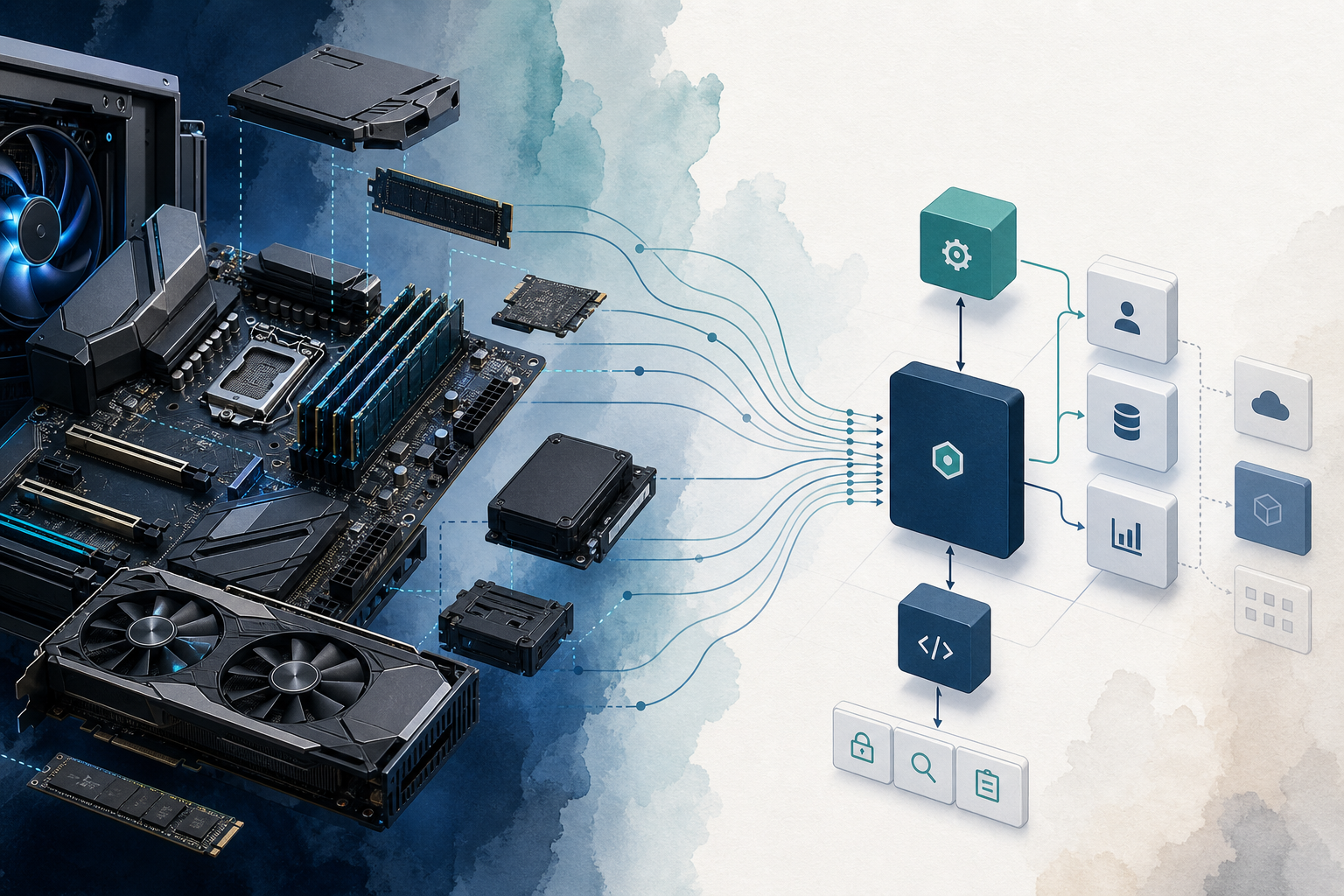
I recently spent time thinking about how to build a machine that could grow with what I ask of it — more RAM when models get larger, a discrete GPU when inference gets serious, faster storage when agents need local datasets. That exercise felt oddly familiar.
It felt like explaining composable architecture on MuleSoft.
The analogy is almost one-to-one: a sealed mini PC is the cheap middleware box that “just works” for today’s problem. An assembled, upgradeable PC is the enterprise platform where you swap and scale parts instead of throwing the whole machine away.
The mini PC trap (and the cheap middleware trap)
A mini PC is tempting. Small. Quiet. Often surprisingly capable for the money. You unbox it, plug it in, and get something useful immediately.
That is exactly how many organisations buy middleware and iPaaS tools for the first integration fire.
You need Salesforce to talk to SAP. Or a portal to call a handful of backend services. Someone brings in a lightweight connector suite, a department licences a mid-tier iPaaS, or a vendor ships an appliance-style integration stack. It works. Leadership is happy. The project closes.
Then the next ask arrives.
- Twice the volume
- Three more systems
- Real-time instead of batch
- Proper security, observability, and reuse across teams
With a sealed mini PC, the fix is often: buy a bigger mini PC. Another chassis. Another full bill. Limited ability to reuse what you already paid for.
With sealed middleware thinking, the fix looks the same: another tool, another silo, another licence, another set of point-to-point flows that nobody else can safely reuse. You solve today’s ticket and quietly create tomorrow’s landscape of brittle stacks.
Cheap and closed works — until the problem outgrows the box.
What assembling a PC actually teaches you
Build a proper desktop and the mindset flips. You choose a motherboard and case that leave headroom. You buy the CPU you need now. You leave PCIe slots open. You pick a PSU that can feed a GPU later. You treat RAM and storage as modules you can upgrade without rebuilding the machine.
| PC part | What you upgrade | Enterprise equivalent |
|---|---|---|
| RAM | More capacity when workloads grow | Scale workers, concurrency, message buffering |
| CPU | More cores when compute tightens | Heavier process orchestration and transformation |
| GPU | Add acceleration when the job changes | New capabilities — AI services, event streams, specialised adapters |
| Storage | Faster / larger disks | Data products, caching, file/object backends behind stable APIs |
| Motherboard / case | The platform that accepts parts | Your API & integration platform (governance, runtime, security) |
| PSU | Power budget for future cards | Operating model, funding, and capacity planning |
You are not buying a finished gadget. You are buying a system that can absorb change.
That is the composable enterprise in hardware form.
MuleSoft’s version of the modular PC
MuleSoft’s composable approach — especially API-led connectivity — is the same idea applied to applications and data.
Instead of one sealed “integration appliance” that embeds every transformation and system call, you assemble reusable capabilities:
- System APIs — unlock systems of record (ERP, CRM, databases) behind stable contracts. These are your motherboard traces: how power and data actually reach the chips.
- Process APIs — orchestrate business logic across those systems. These are the workloads that run on the CPU once the board can talk to everything.
- Experience APIs — shape data for channels: mobile, portal, partner, agent. These are the monitors and peripherals — what the outside world actually sees.
Governance, Anypoint Exchange, policies, and shared runtimes are the case and cooling: without them, modules collide and the machine overheats under load.
When a new channel appears, you do not buy a second mini PC. You add or extend an Experience API. When a backend is replaced, you swap the System API implementation without rewriting every consumer. When AI enters the picture, you plug a new capability into process and experience layers — like seating a GPU into an open PCIe slot you left intentionally free.
Point-to-point is soldered-on peripherals
Imagine if every USB device on your desk required its own non-removable solder joint on the motherboard. Want a new webcam? Resolder. Better keyboard? Start over.
That is classic point-to-point integration: each project hard-wires Salesforce to billing, billing to logistics, logistics to a spreadsheet export. It works for the demo. It fails the upgrade test.
Composable architecture replaces solder with sockets. Contracts. Versioning. Reuse. You pay a little more up front for the board — the platform and the discipline — so that later change is an upgrade, not a rip-and-replace.
When the mini PC (or cheap middleware) is still the right call
I am not against mini PCs. I just wrote about running a serious local LLM on one. They are excellent when the problem is bounded: a lab, a personal agent, a proof of concept, a department with a fixed scope and a short horizon.
Cheap middleware is fine under similar conditions:
- One or two systems, limited growth expected
- Exploratory project with a clear sunset date
- No mandate to share capabilities across the enterprise
Trouble starts when the temporary box becomes the permanent factory floor — and every new requirement means a bigger sealed unit instead of a new module.
How to buy like you are building a PC
If you are advising on integration platforms, ask the same questions a good PC builder asks:
- Can I upgrade parts independently? Or does growth force a full product change?
- Are there open “slots”? Can I publish new APIs and capabilities without forking the whole estate?
- Is there a shared bus? Security policies, observability, catalogues, and ownership — or every team invents their own?
- Am I paying for chassis or for composability? Sealed kits look cheaper on day one. Modular platforms look cheaper on year three.
- Does the power budget exist? Skills, Centre for Enablement, funding model. A motherboard without a PSU is still a paperweight.
MuleSoft’s answer to those questions is deliberately “modular PC,” not “bigger mini PC.” Experience, Process, and System layers; reusable assets; governed runtimes. You invest in the platform that accepts change.
Closing the loop
Assembling a PC taught me something I already believed as an integration person — but felt differently when my hands were on the parts:
Capability you cannot upgrade is cost you will pay twice.
A sealed mini PC solves today’s workload until the next one appears. Then you buy another box. Sealed middleware thinking does the same to the enterprise.
Composable architecture — the MuleSoft way — is choosing the motherboard first: APIs as sockets, processes as workloads, experiences as devices you can plug in and replace. Add RAM. Add a GPU. Add storage. Keep the machine.
That is how you build both a PC and an enterprise that last longer than the first problem you bought them for.
If you want to talk through whether your current estate is a mini PC stack or a modular build — discovery, architecture, or MuleSoft composability — I am happy to dig in on Topmate or LinkedIn.